Rowden hosts Army Sergeant Majors as part of ARRC development programme on Techcraft
11.03.2026
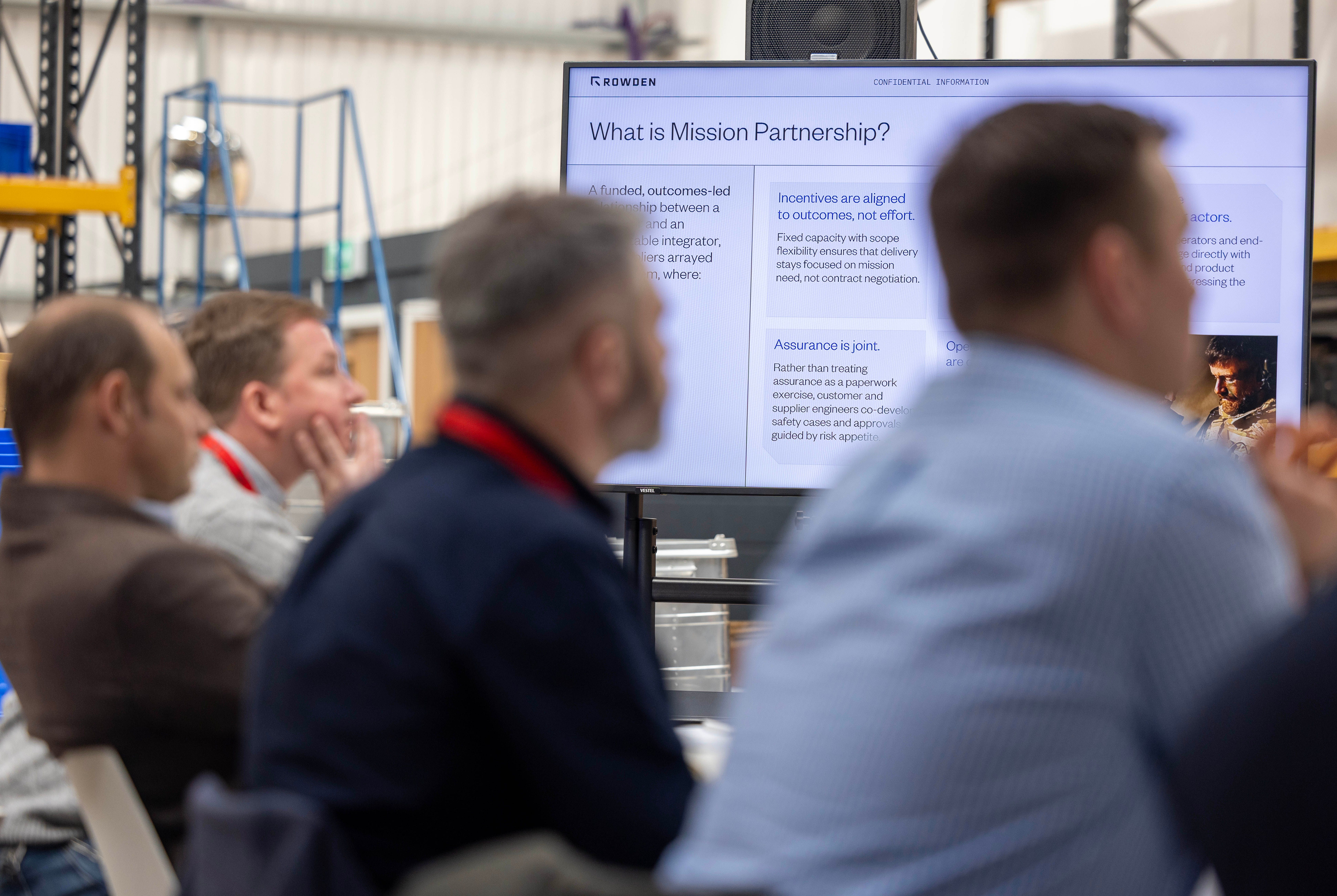
Rowden hosted a group of Army Sergeant Majors in March as part of a professional development programme linked to the Allied Rapid Reaction Corps (ARRC). While the programme focused on Corps-level operations and NATO, the visit to Rowden shifted the conversation into a different space, one focused on how capability is designed, built and sustained in practice.
Discussions began with defence industrial relationships and incentives. A consistent theme was the role of senior soldiers in setting and maintaining standards. Suboptimal systems rarely fail quietly, and they persist when they are not challenged. Clear, direct engagement with industry, particularly on incentives and delivery models, remains one of the most effective levers available to users.
Rowden then briefed on the mission partnership with the Army, delivering capability through Human Machine Teaming and ASGARD. These programmes demonstrate a different operating model, where engineers, operators and product owners work in close proximity and delivery is measured against operational outcomes rather than activity. In this model, assurance is developed alongside the system and feedback loops between user and developer are significantly shorter.
Attention then turned to the realities of deploying advanced technology in contested environments. Sessions covered the constraints of running machine learning models on edge platforms, the changing character of the electromagnetic spectrum, and the growing requirement for electronic warfare and force protection capabilities that can be used beyond specialist teams. Designing for “walk-up” operation, where systems can be employed effectively with minimal training, was identified as a critical factor in scaling capability across the force.
The second half of the visit focused on practical engagement. Participants worked with Rowden engineers to understand how user-centred design informs software development, before moving into the assembly space to review the configuration and operation of Rowden’s sensing and communications capabilities.
The visit concluded with a discussion on a challenge that is becoming increasingly prominent. As systems become more software-defined and more widely distributed, the constraint shifts toward managing them at scale. Provisioning, configuration control, and lifecycle management of large device fleets are emerging as operational problems in their own right, with direct implications for adaptability and tempo.
Engagements of this kind provide an opportunity to connect operational experience with engineering practice. The Sergeant Majors brought a clear understanding of what is required in the field, and how standards are enforced in reality. Those perspectives are essential in shaping systems that are not only technically advanced, but usable, resilient, and trusted by the people who depend on them.
follow us
locations
Bristol
Paddington, London
contact us
info@rowdentech.com
+44 (0)117 3131236
registered address:
Unit G3C Bolingbroke Way Bristol England BS34 6FE
ROWDEN TECHNOLOGIES 2026©